



The ISO 9001:2026 transition dates are confirmed. Global ACI published them on 16 September 2026, the same day ISO released the new edition of the standard. The final deadline is 30 September 2029.
If your first reaction is "not another change", you are in good company.
Change, change, change
Think about what has landed on your desk since 2015. Risk-based thinking and the Annex SL structure. ISO 45001 in 2018. The climate change amendments in 2024, which arrived with no warning and no transition period. ISO 14001 now moving to a 2026 edition. And now ISO 9001 itself.
Every one of these brings the same round of work. Update the documented information. Re-brief the internal auditors. Explain to the board why the certificate costs more this year. Answer the question you hear every time: do we have to do this?
So here is the honest version. The standard has changed. The rules for moving your certificate across have now been confirmed. You have three years. Three years sounds generous until you map it against your own audit cycle, which is where most organizations lose their buffer.
Who is Global ACI, and why do their dates matter?
Global ACI (Global Accreditation Cooperation Incorporated) began operations on 1 January 2026. The body brings together the former International Accreditation Forum (IAF) and the International Laboratory Accreditation Cooperation (ILAC) into a single international body for conformity assessment.
Global ACI sets the rules your accreditation body follows. In Australia and New Zealand, your accreditation body is JAS-ANZ. Your accreditation body then sets the rules your certification body follows. The document driving this transition is Global ACI-TECH-3-TR 2029-09-30 (M), published 16 September 2026. The (M) marks a mandatory document, so accreditation bodies and certification bodies apply the dates rather than interpret them.
This matters to you for one reason. The dates below are not a certification body marketing position or a consultant’s opinion. They are the timetable your certificate sits inside. You will find the announcement here: Global ACI publishes transition requirements for ISO 9001:2026.
The confirmed timeline
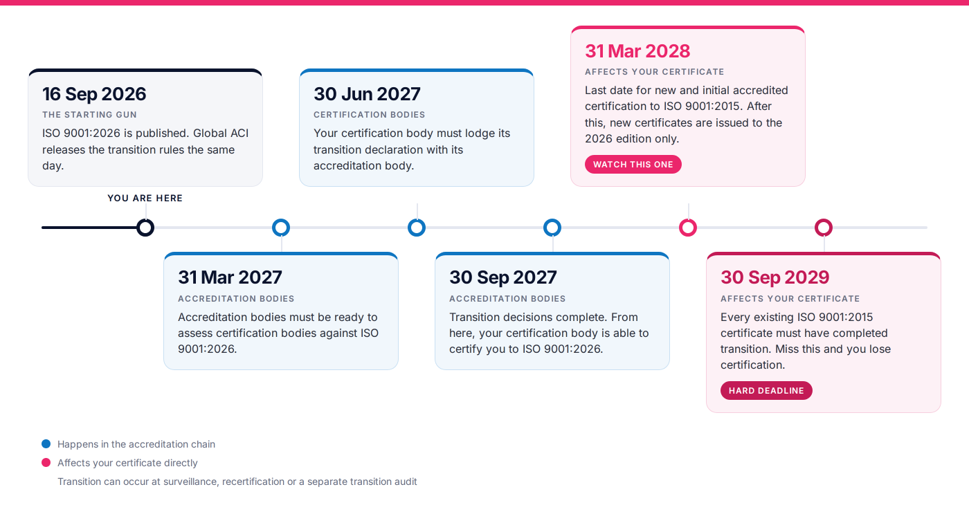
Follow the timeline from left to right. The blue points happen in the accreditation chain, behind the scenes. The pink points hit your certificate directly.
What each date means for you
- 31 March 2027: accreditation bodies ready. Accreditation bodies must be ready to support ISO 9001:2026. Nothing for you to do. This is the machinery starting up.
- 30 June 2027: certification bodies declare. Your certification body must submit its transition declaration to its accreditation body. Worth asking your account manager about at your next surveillance audit.
- 30 September 2027: transition decisions complete. Accreditation body transition decisions are finished. From this point your certification body is in a position to certify you to the 2026 edition.
- 31 March 2028: the cut-off for new 2015 certificates. New and initial accredited certifications are issued to ISO 9001:2026 only. If you are certifying a new site or a new business after this date, you go straight to the 2026 edition.
- 30 September 2029: the hard deadline. Every existing ISO 9001:2015 certification must have completed transition.
Transition itself happens at a surveillance audit, at a recertification audit, or at a separate transition audit. You have a choice, and the choice has cost and timing consequences. More on this below.
The two dates people will mix up
Write these two side by side, because they will be confused in every conversation you have over the next two years.
- 31 March 2028 is the cut-off for new ISO 9001:2015 certifications.
- 30 September 2029 is the deadline for existing ISO 9001:2015 certificates to complete transition.
- Which audit is your transition audit? Folding transition into a scheduled surveillance or recertification audit usually costs less than a standalone transition audit. The trade-off is preparation time. A surveillance audit in late 2027 means your system meets the 2026 requirements by late 2027, not by 2029.
- When is your certification body ready? Their accreditation decision completes by 30 September 2027 at the latest. Ask for their planned date in writing.
- How much extra audit time applies? Transition audits attract additional duration. Get the number early so your next budget carries it.
- Where does your recertification fall? A recertification audit in 2029 is the tightest position to be in. Certification body capacity in the final two quarters of 2029 will be under pressure, and a non-conformity raised at that audit needs closing before the deadline, not after.
The difference is between starting fresh and moving across. If you acquire a business in mid 2028 and want the site certified, the site goes to ISO 9001:2026. There is no option to add it to a 2015 certificate. Your existing certified sites keep running under the 2015 edition until you transition them, with 30 September 2029 as the outer limit.
Anyone quoting 2028 as "the deadline" to you has merged the two. Anyone treating 2029 as permission to wait has missed how certification body capacity works.
What happens if you miss 30 September 2029
Your ISO 9001:2015 certificate is no longer valid. This is not a grace period with a fee attached. The certificate lapses, and re-entry means an initial certification audit, which is stage one and stage two in full.
Think about who asks you for the certificate. Tender portals. Prime contractors. Insurers. Government panels. A lapsed certificate creates a gap in supplier prequalification at the exact moment you have no quick way to close it.
Plan backwards from your audit cycle, not forwards from today
Here is the part most organizations get wrong. They look at 30 September 2029, see three years, and put the work aside. The useful exercise is different. Open your certification schedule and find which audit will carry the transition.
Work through this with your certification body.
A sensible target: complete transition by the end of 2028. That leaves three quarters of contingency for a re-audit, a corrective action round, or a change of certification body.
One more thing if you also hold ISO 14001
The ISO 14001:2026 transition runs on its own timetable, and every milestone falls five months earlier than the quality one. The environmental deadline is 30 April 2029, not 30 September 2029.
Plan an integrated management system to the earlier clock and the later one takes care of itself.
The opportunity inside the change
Every transition gets treated as a documentation exercise. Update the manual, renumber the procedures, pass the audit. Three years later nothing about the business has improved and the next revision arrives to the same groan.
The 2026 edition asks about quality culture, ethical behaviour and how leadership builds both. Those requirements are difficult to fake in an audit and difficult to write into a procedure. They give you a reason to ask better questions inside your own organization. What does quality mean to the people doing the work? Where does our culture push against our stated objectives? Who in leadership owns the answer?
Use the transition as the reason to have those conversations. That is the difference between doing ISO and leading it.
Auditor Training Online runs ISO 9001:2026 transition training for internal auditors and quality managers.
/9001%20Specialist.jpg?width=700&name=9001%20Specialist.jpg)
ISO 9001:2026 Quality Management Systems Specialist
AU$1,195.00Explore our Quality Management Systems courses, including ISO 9001:2026 specialist, transition and auditor training, so you can choose the pathway that best fits your role and goals.
What to do in the next 90 days
- Buy the standard and read Annex A. The 2026 edition includes a new guidance annex explaining the intent of the requirements. This is new, and useful for briefing your management team.
- Send two questions to your certification body. When will you be accredited to certify to ISO 9001:2026, and which of my scheduled audits do you recommend as the transition audit?
- Run a gap analysis. Focus on the areas with real change: quality culture and ethical behaviour under leadership, climate change within your organizational context, and the separation of risk from opportunity in clause 6.1.
- Brief top management properly. The leadership requirements have expanded. Top management owns the quality culture requirement. A procedure written by the quality manager and signed at the bottom will not satisfy it.
- Update internal auditor competence. Your internal audit programme has to test the new requirements before your transition audit, which means your internal auditors need the new edition well before your certification body arrives.
- Put the five dates in your management review agenda. Transition status becomes a standing item until your new certificate is issued.