

Leadership • 19 September 2023, 8:00:00 am AEST • Author: Jackie Stapleton
/LTS%202023/Ed%2015/LTS%202023-15%20Feature%20Image.png)
Continual improvement is a concept that pervades both personal development and professional environments, such as quality management systems. It's not about dramatic, overnight changes but rather the consistent, incremental improvements that lead to excellence. A personal experience of mine captures this idea perfectly.
Between the ages of 7 and 17, I dedicated myself to competitive swimming. Each day began and ended with 2-hour training sessions, a routine that required passion and commitment. My focus wasn't merely on winning races but on improving every aspect of my performance: refining my technique, perfecting my starts, turns, and finishes, and setting new Personal Bests (PBs).
The path wasn't always smooth; fatigue sometimes led to dozing off during class, but the setbacks were outweighed by the satisfaction of improvement. These experiences cultivated a love for the challenge of bettering myself, an amazing sensation that goes beyond mere achievement.
In many ways, this mirrors the practice of continual improvement in quality management systems. Like the diligent refinement of my swimming skills, quality management involves a continual effort to enhance processes and optimize performance. The parallel extends to the workplace as well, where consistent evaluation, learning, and adaptation can lead to significant improvements in efficiency and effectiveness.
The gratification that comes from progress, both in personal pursuits and professional domains, stems from embracing the journey rather than merely focusing on the destination. The satisfaction of improvement isn't confined to immediate victories; it's in the daily dedication to growth and the unwavering pursuit of excellence.
My journey as a swimmer reflects a universal principle that can be applied across various aspects of life, including quality management. The continual quest for improvement, marked by persistence, resilience, and joy in the process, serves as a roadmap for success in both personal development and professional endeavours.
"Continual improvement is an unending journey" – Lloyd Dobyns & Clare Crawford-Mason (American documentary journalists on business and quality)
And of course, for continual improvement to continue as this unending journey process improvements have to be maintained. In this HBR article Making Process Improvements Stick it was observed that:
- Projects with strong support from the head office showed 35% greater improvement after a year than ones without that support
- They were also less likely to backslide, with 79% performing above baseline after a year, compared with 61% of projects not driven by the head office
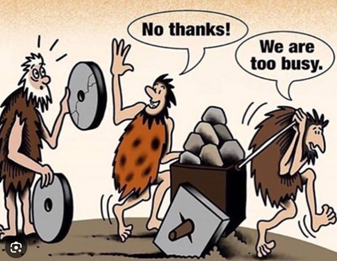
The Square Wheel Dilemma: Choosing Progress Over Complacency
The well-known image of cavemen struggling to push a cart with square wheels, too busy to consider the more efficient alternative of round wheels, is a striking reminder of the importance of continual improvement in our modern lives. Just like the cavemen, we often find ourselves caught in the daily grind, overwhelmed by immediate tasks and challenges, and failing to recognize opportunities for growth and advancement.
The resistance to adopt round wheels represents a resistance to change and an inability to see beyond the status quo, even when that change could lead to significant improvements. This metaphor teaches us that, in business and personal development, it is essential to take the time to reflect, innovate, and make incremental changes that may feel slow or uncomfortable at first but can lead to profound advancements in efficiency and success over time.
The concept of continual improvement reminds us to never be complacent with current methods when better solutions may be just around the corner, waiting to be discovered.
Navigating Success: The Unending Journey of Improvement
In the relentless pursuit of personal and professional excellence, the journey often follows a familiar path, much like the laps in a swimming pool. Aligning with the traditional Plan-Do-Check-Act model of continual improvement, we embark on a process of 'Prepare, Execute, Evaluate, and Adapt', a rhythm that resonates with our personal journeys, the diligent refinement of quality management, and the unwavering commitment to bettering ourselves each day.
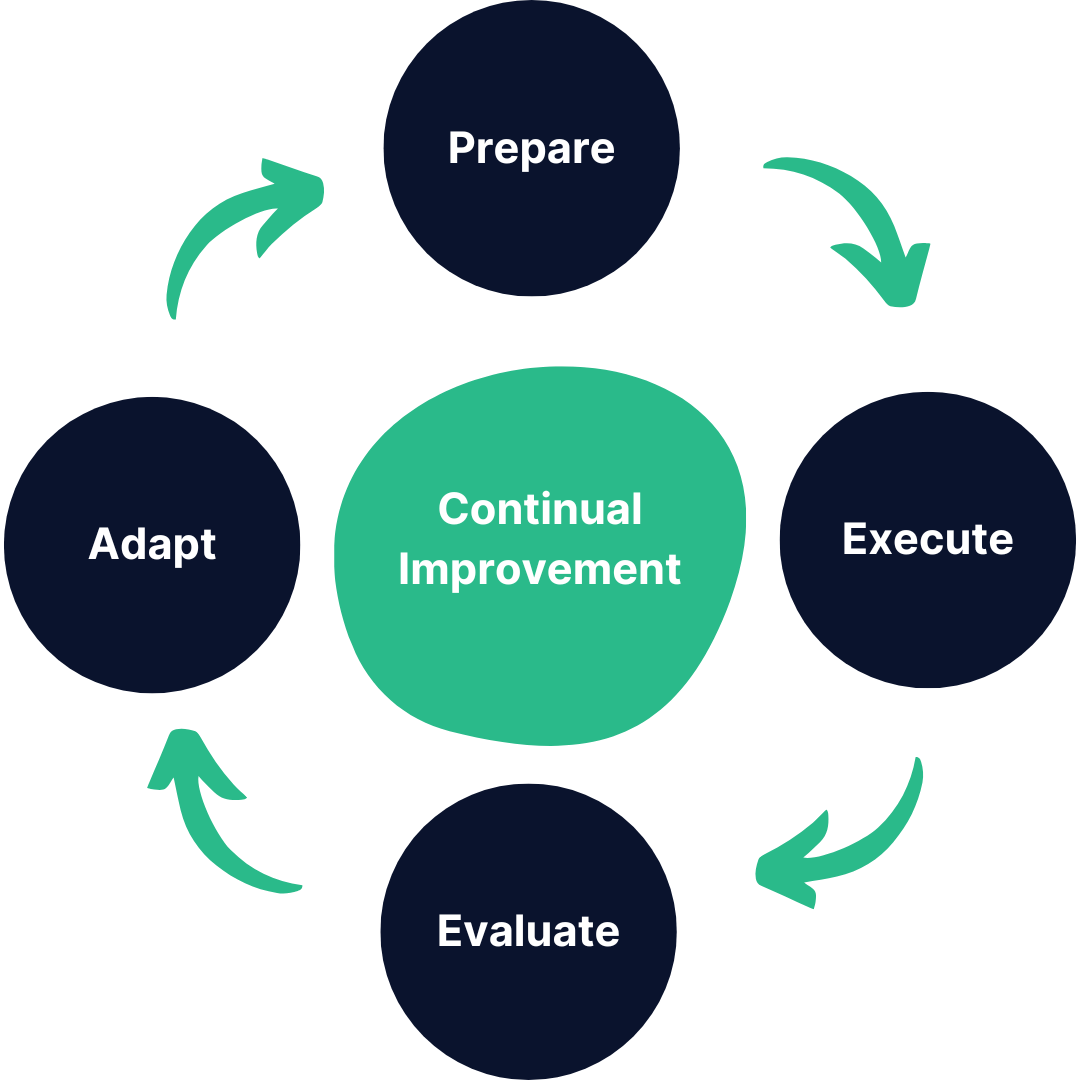
Prepare
Similar to the initial stages of training and developing swimming skills, this phase involves setting goals, planning strategies, and preparing for the journey. In professional settings, this might equate to mapping out process improvements and setting quality targets.
Execute
Reflecting the daily 2-hour training sessions, relentless practice, and dedication to refining every aspect of performance, this phase is about implementing the plans. In the context of quality management, it is the execution of the planned improvements.
Evaluate
This can be likened to the consistent evaluation in swimming performance, examining techniques, starts, turns, finishes, and setting new Personal Bests. In a business context, this is about assessing the effectiveness of changes and seeing if the improvements are on track, similar to the study mentioned in the HBR article.
Adapt
This phase could resonate with the idea of not just focusing on the destination but embracing the journey. Like the continual quest for improvement in swimming and overcoming setbacks, this phase is about making necessary adjustments and continuing to strive for excellence. In a quality management scenario, this involves making continual refinements and enhancements to ensure sustained progress.
Your Next Steps

Management Systems Auditor (ISO 19011:2026)
AU$1,195.00Build lead auditor and audit team capability with ATOL's Management Systems Auditor course for internal and external auditors, fully aligned to ISO 19011:2026. Exemplar Global recognised online training.
1. Identify processes that support continual improvement.
2. Support actions to improve performance.
3. Work with the consultant to understand the process.
4. Share with management and workers.
Continue the Conversation with the LTS Podcast
This article is just the beginning. Join us for the extended discussion on the podcast, available on Spotify and YouTube